
Magnetic Tentacles

Catheters with highly flexible body controlled by external magnetic fields

OverviewApplications
Lung tumour biopsyCardiovascular surgeryBronchoscopyTargeted drug deliveryPancreatic CancerSkull Base SurgeryNeurosurgery

Magnetic tentacle robots have the potential to be thin, extremely soft and scalable, and to conform to curvilinear trajectories by leveraging magnetic control over their entire length. The surgeon needing to access difficult to reach targets such as peripheral nodules in the lungs, deadly diseases in the pancreas and regions deep inside the skull, will be able to design personalised tentacles and fabricate them on demand. At the STORM Lab, we are exploring new robotic architectures, as well as the design and fabrication processes integral to this novel concept.

fewmm
Tentacle diameter
17%
Perforation risk in current practice
33
Relevant publications
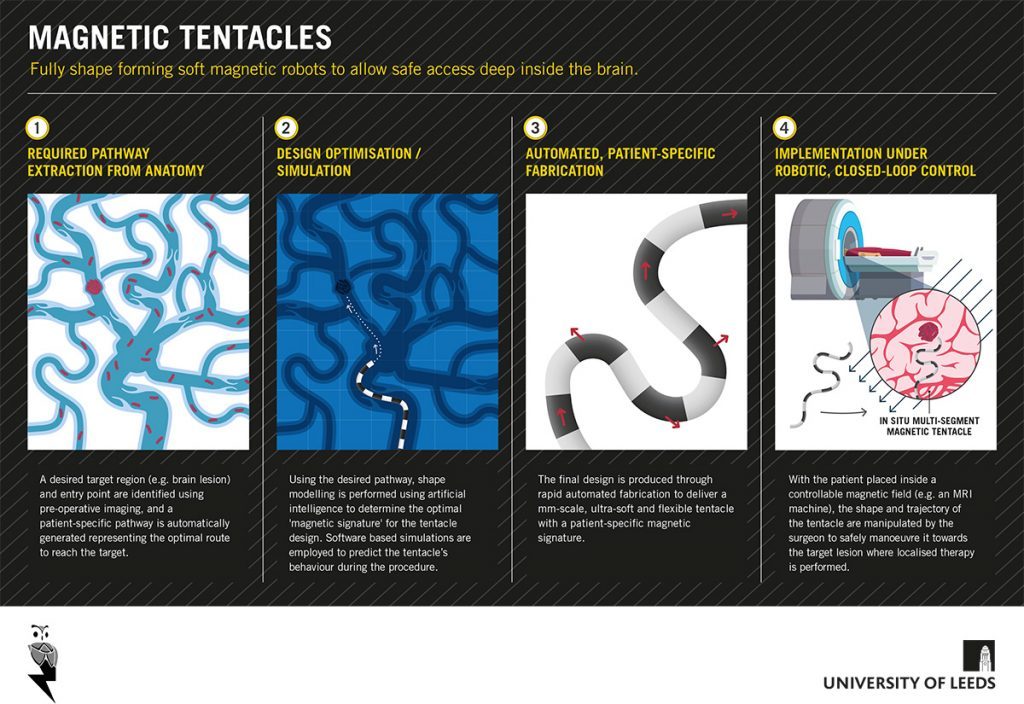
Magnetic tentacle robots — principle of operation
Relevant publications [33]
  1. 01
    Tapered Magnetic Soft Continuum Catheters with Integrated Microchannels for Cerebral Intra-Arterial Chemotherapy Delivery
    A. Bacchetti, P. Lloyd, M. Brockdorff, et al.
    Soft Robotics Apr 2026 doi:10.1177/21695172261438681
  2. 02
    A concentric tube catheter for endoluminal interventions, steered and imaged via magnetic resonance imaging
    P. Lloyd, N. Murasovs, Y. L. May, et al.
    Communications Engineering Mar 2026 doi:10.1038/s44172-026-00636-1
  3. 03
    Miniaturized Magnetic Tip Design for Endoluminal Vine Robot Navigation
    A. Yanez Trujillo, J. Davy, J. H. Chandler, et al.
    Advanced Robotics Research Feb 2026 doi:10.1002/adrr.202500188
  4. 04
    Ultrasound-Triggered Release of Anticancer Nanoparticles from Electrospun Fabrics Integrated with Soft Robotic Tentacles
    S. C. T. Moorcroft, B. Calmé, C. Brooker, et al.
    Advanced NanoBiomed Research 2026 doi:10.1002/anbr.202500052
  5. 05
    Combining tethered and untethered magnetic robots via a magnetically triggerable latch for target payload delivery and retrieval
    M. Brockdorff, B. Calmé, T. Wang, et al.
    Science Advances 2026-01 doi:10.1126/sciadv.adu6025
  6. 06
    Gradient pulling of a tethered robot via a magnetic resonance imaging system
    N. Murasovs, P. Lloyd, A. Bacchetti, et al.
  7. 07
    Closed-Loop Shape-Forming Control of a Magnetic Soft Continuum Robot
    V. Francescon, N. Murasovs, P. Lloyd, et al.
    IEEE Robotics and Automation Letters Apr 2025 doi:10.1109/LRA.2025.3565124
  8. 08
    Magnetic localization during manipulation by two robotized permanent magnets
    T. da Veiga, M. Brockdorff, G. Pittiglio, et al.
    The International Journal of Robotics Research Apr 2025 doi:10.1177/02783649251317212
  9. 09
    Magnetic Fluid-Driven Vine Robots for Minimally Invasive Tissue Biopsy Sampling
    J. Davy, T. P. Dean, N. J. Greenidge, et al.
    Advanced Intelligent Systems Mar 2025 doi:10.1002/aisy.202400827
  10. 10
    Utilizing Field Gradient Measurements for Object Tracking in Permanent Magnet based Manipulation Systems
    J. Davy, M. Brockdorff, P. Valdastri
    IEEE Transactions on Magnetics 2025-03 doi:10.1109/TMAG.2025.3553740
  11. 11
    High-Resolution Self-Assembly of Functional Materials and Microscale Devices via Selective Plasma Induced Surface Energy Programming
    L. J. Tinsley, P. Karipoth, J. H. Chandler, et al.
  12. 12
    Hybrid Tendon-Actuated and Soft Magnetic Robotic Platform for Pancreatic Applications
    B. Calmé, A. Metcalf, M. Brockdorff, et al.
    IEEE Robotics and Automation Letters 2024-12 doi:10.1109/LRA.2024.3524889
  13. 13
    Vine Robots with Magnetic Skin for Surgical Navigations
    J. Davy, N. Greenidge, S. Kim, et al.
    IEEE Robotics and Automation Letters 2024-08 doi:10.1109/LRA.2024.3412637
  14. 14
    Future cardiovascular healthcare via magnetic resonance imaging-driven robotics
    P. Lloyd, E. Dall'Armellina, J. E. Schneider, et al.
    European Heart Journal 2024-07 doi:10.1093/eurheartj/ehae095
  15. 15
    Dual-Material Aerosol Jet Printing of Magneto-Responsive Polymers with In-Process Tailorable Composition for Small-Scale Soft Robotics
    S. Taccola, E. al
    [Manuscript submitted for publication] 2024-06 doi:10.1002/ADMT.202400463
  16. 16
    Assisted Magnetic Soft Continuum Robot Navigation via Rotating Magnetic Fields
    D. Chathuranga, P. Lloyd, J. H. Chandler, et al.
    IEEE Robotics and Automation Letters 2024-01 doi:10.1109/LRA.2023.3331292
  17. 17
    Breathing Compensation in Magnetic Robotic Bronchoscopy via Shape Forming
    N. Murasovs, V. Francescon, P. Lloyd, et al.
    IEEE Robotics and Automation Letters 2024 doi:10.1109/LRA.2024.3426385
  18. 18
    Independently Actuated Soft Magnetic Manipulators for Bimanual Operations in Confined Anatomical Cavities
    Z. Koszowska, M. Brockdorff, T. da Veiga, et al.
    Advanced Intelligent Systems 2024 doi:10.1002/aisy.202300062
  19. 19
    Closed Loop Static Control of Multi-Magnet Soft Continuum Robots
    G. Pittiglio, A. L. Orekhov, T. Da Veiga, et al.
    IEEE Robotics and Automation Letters 2023-07 doi:10.1109/LRA.2023.3274431
  20. 20
    Personalized magnetic tentacles for targeted photothermal cancer therapy in peripheral lungs
    G. Pittiglio, J. H. Chandler, T. da Veiga, et al.
    Communications Engineering 2023-07 doi:10.1038/s44172-023-00098-9
  21. 21
    A Framework for Simulation of Magnetic Soft Robots Using the Material Point Method
    J. Davy, P. Lloyd, J. H. Chandler, et al.
    IEEE Robotics and Automation Letters 2023-06 doi:10.1109/LRA.2023.3268016
  22. 22
    A Magnetically-Actuated Coiling Soft Robot With Variable Stiffness
    P. Lloyd, T. L. Thomas, V. K. Venkiteswaran, et al.
    IEEE Robotics and Automation Letters 2023-06 doi:10.1109/LRA.2023.3264770
  23. 23
    Six-Degree-of-Freedom Localization under Multiple Permanent Magnets Actuation
    T. Da Veiga, G. Pittiglio, M. Brockdorff, et al.
    IEEE Robotics and Automation Letters 2023-06 doi:10.1109/LRA.2023.3268588
  24. 24
    Collaborative Magnetic Manipulation via Two Robotically Actuated Permanent Magnets
    G. Pittiglio, M. Brockdorff, T. Da Veiga, et al.
    IEEE Transactions on Robotics 2023-04 doi:10.1109/TRO.2022.3209038
  25. 25
    Independent and Hybrid Magnetic Manipulation for Full Body Controlled Soft Continuum Robots
    K. Abolfathi, J. A. Rosales-Medina, H. Khaksar, et al.
    IEEE Robotics and Automation Letters 2023 doi:10.1109/LRA.2023.3280749
  26. 26
    Independent Control of Two Magnetic Robots using External Permanent Magnets: A Feasibility Study
    J. Davy, T. Da Veiga, G. Pittiglio, et al.
    2023 International Symposium on Medical Robotics, ISMR 2023 2023 doi:10.1109/ISMR57123.2023.10130246
  27. 27
    Patient-Specific Magnetic Catheters for Atraumatic Autonomous Endoscopy
    G. Pittiglio, P. Lloyd, T. Da Veiga, et al.
    Soft Robotics 2022-12 doi:10.1089/soro.2021.0090
  28. 28
    Optimization and fabrication of programmable domains for soft magnetic robots: A review
    A. Bacchetti, P. Lloyd, S. Taccola, et al.
    Frontiers in Robotics and AI 2022-11 doi:10.3389/frobt.2022.1040984
  29. 29
    Magnetic Soft Continuum Robots With Braided Reinforcement
    P. Lloyd, O. Onaizah, G. Pittiglio, et al.
    IEEE Robotics and Automation Letters 2022-10 doi:10.1109/LRA.2022.3191552
  30. 30
    Evolutionary Inverse Material Identification: Bespoke Characterization of Soft Materials Using a Metaheuristic Algorithm
    M. Di Lecce, O. Onaizah, P. Lloyd, et al.
    Frontiers in Robotics and AI 2022-01 doi:10.3389/frobt.2021.790571
  31. 31
    Feasibility of Fiber Reinforcement Within Magnetically Actuated Soft Continuum Robots
    P. Lloyd, Z. Koszowska, M. Di Lecce, et al.
    Frontiers in Robotics and AI 2021 doi:10.3389/frobt.2021.715662
  32. 32
    A Learnt Approach for the Design of Magnetically Actuated Shape Forming Soft Tentacle Robots
    P. Lloyd, A. K. Hoshiar, T. Da Veiga, et al.
    IEEE Robotics and Automation Letters 2020 doi:10.1109/LRA.2020.2983704
  33. 33
    Challenges of continuum robots in clinical context: A review
    T. Da Veiga, J. H. Chandler, P. Lloyd, et al.
    Progress in Biomedical Engineering 2020 doi:10.1088/2516-1091/ab9f41