
What if a deep brain implant could be put in place without conventional brain surgery?
That’s the question behind ARIA’s new Massively Scalable Neurotechnologies programme. We’re very pleased to share that STORM Lab is part of it.
The big idea
Neurological and neuropsychiatric disorders are the leading cause of disability worldwide. The most advanced treatments, such as deep brain stimulation, still rely on complex brain surgery. That limits them to the most severe cases and puts early intervention out of reach for millions of people.
ARIA (the UK’s Advanced Research and Invention Agency) has put £50m behind a different approach: neurotechnologies that reach the brain through the body’s natural pathways. The goal is a responsive system that can monitor and adjust brain activity, and that can be deployed in under 30 minutes. The programme is part of ARIA’s wider Scalable Neural Interfaces opportunity space.
Enter the vines
Our project, VINES: Vine Robots for Intracranial Navigation and Endocisternal Stimulation, is led by Prof. Pietro Valdastri. It is one of ten Creator teams funded through the programme.
A consortium led by the University of Leeds is exploring whether the fluid-filled spaces around the brain and spinal cord could provide a less invasive route for placing deep-brain implants. Its proposed tool is a tiny, soft robot inspired by a growing vine. It advances from its tip instead of pushing its entire body along delicate tissue, and external magnets help steer it through spaces filled with cerebrospinal fluid. Once it reaches a suitable location, it would place a miniature electrical implant into brain tissue and then be withdrawn. The implant would be powered wirelessly, with no implanted battery. If the approach works, it could offer a new way to reach brain regions currently treated with deep-brain stimulation, while avoiding surgery through the skull. The wider ambition is to make these interventions simpler and available to more people.
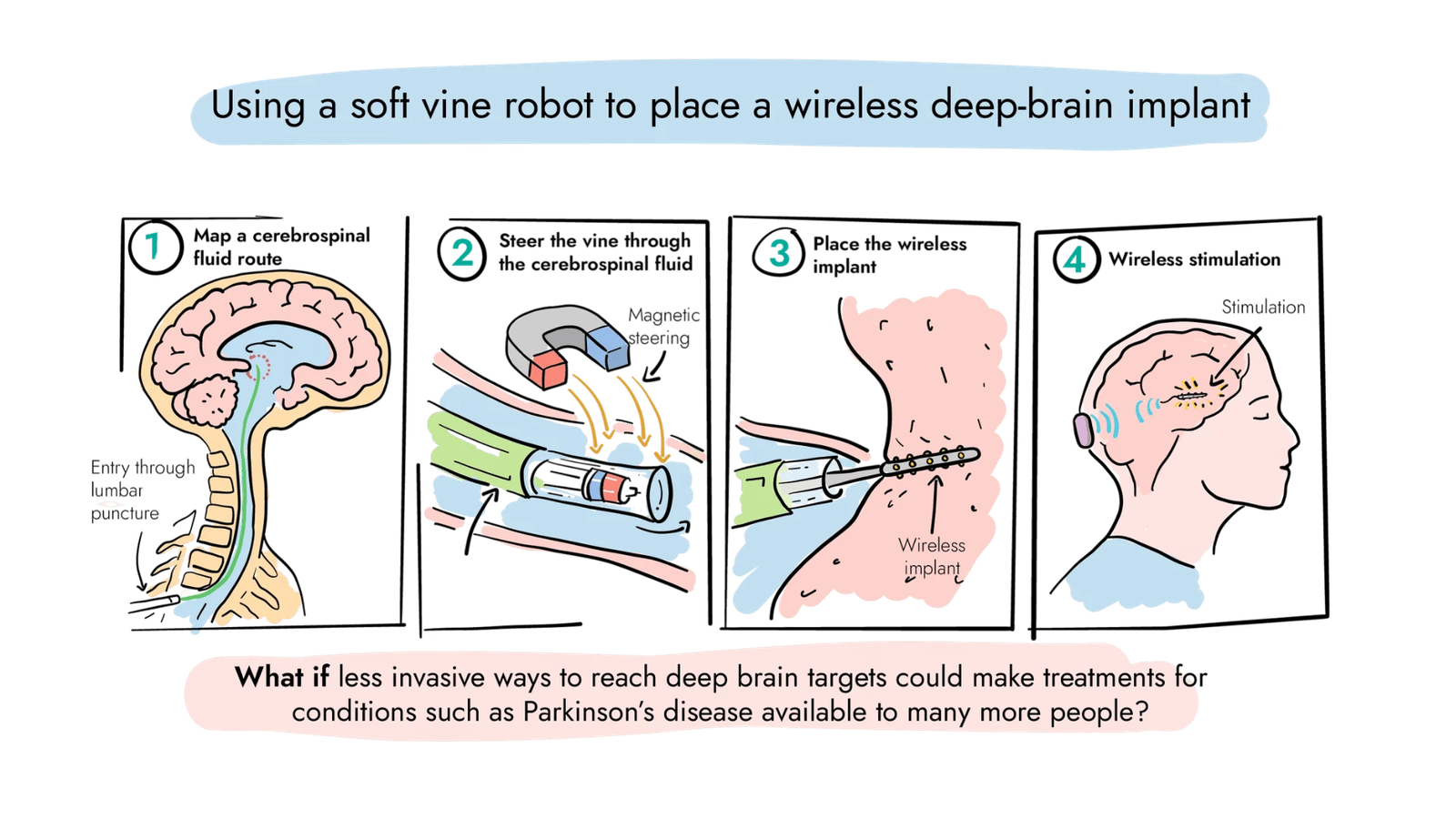
This builds directly on our recent work: vine robots with magnetic skin, external magnetic steering, Josh Davy’s magnetic fluid-driven vines, which shrank the whole idea down to just a few millimetres, and Andrea Yanez’s magnetic tip mount for a 7 mm vine. The vines have spent the last few years learning to grow through lungs. Now they’re being pointed at the brain.
Good company
The ten teams’ approaches include engineered immune cells, inhaled particles, ultrasound contrast agents, endovascular devices and magnetic nanotransducers, from groups at MIT, Imperial, Edinburgh, UCL, EPFL and elsewhere. Each project is a 36-month preclinical feasibility study. The aim is to find out which approaches are safe, well targeted and technically credible enough to take further.
You can read more about the programme on ARIA’s website, and explore all ten funded projects here.